
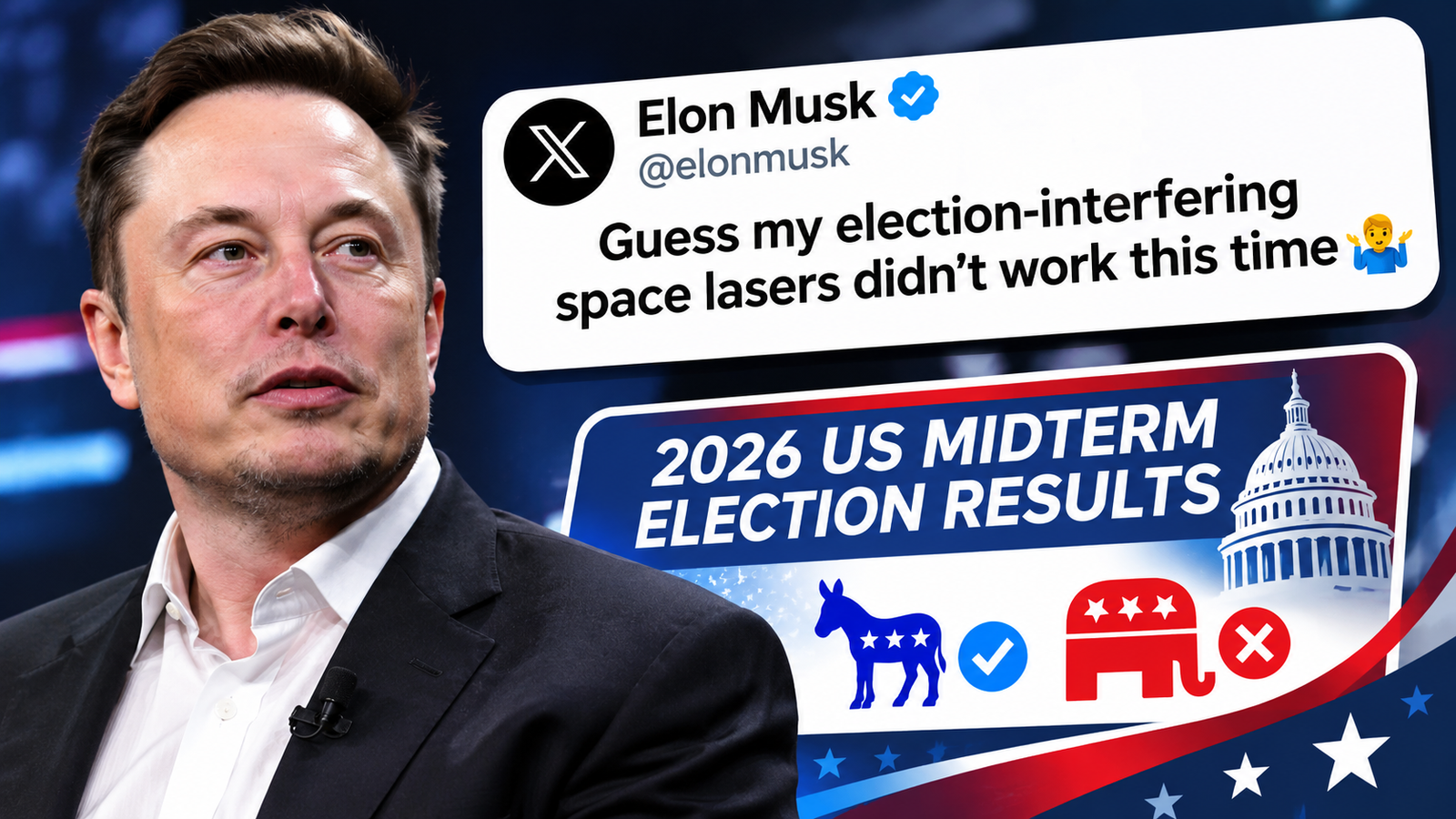
A billionaire spending heavily to influence an election is hardly surprising. But joking about imaginary space lasers after the candidates he supported lose? That is the kind of unexpected political moment that quickly attracts attention online.
On November 4, 2026, Elon Musk responded to major Republican election losses with a sarcastic post on X, the social media platform he owns.
The Elon Musk Space Lasers Joke arrived just hours after the 2026 US midterm elections delivered significant victories for Democrats, including unexpected results in Texas.
Rather than issue a lengthy political statement, the Tesla and SpaceX CEO appeared to use humor to acknowledge the outcome.
His separate comment about placing AI data centers in space added another layer to the story, connecting the election results with his business interests and wider concerns about technology infrastructure.
The combination of political disappointment, billionaire influence, space technology, and online humor made the posts an immediate subject of news coverage.
Key Takeaways
- Elon Musk posted a sarcastic space lasers joke on X early November 4, 2026, after major Republican defeats in the US midterm elections.
- Democrats won control of both chambers of Congress, with Texas delivering particularly significant results.
- Musk’s political spending placed him among the most influential financial backers of Republican campaigns.
- His separate comment about space-based data centers raised questions about the future of AI infrastructure under changing political leadership.
What Did Elon Musk Say About Space Lasers After the 2026 Midterm Elections?
Elon Musk joked that his imaginary election-interfering space lasers had failed after Republicans suffered major losses in the November 3, 2026, midterm elections. The sarcastic X post appeared early the following morning and became a notable part of the reaction to the Democratic victories. There is no evidence that actual space lasers were involved.
Musk’s post on X
“Guess my election-interfering space lasers didn’t work this time 🤷♂️”
Elon Musk, November 4, 2026
The remark was posted shortly before 1:15 a.m. Eastern Time, according to Axios. Axios
Musk’s wording was deliberately absurd. Space lasers are not a real explanation for election outcomes, and the comment should be understood as sarcasm rather than an admission of wrongdoing.
What made the post noteworthy was its timing.
Musk had supported Republican candidates financially and publicly. The election results therefore represented more than an ordinary political event for him.
His response offered a glimpse of how he chose to address the setback in public, without explaining what he thought went wrong or whether he intended to change his political involvement.
The shrugging emoji reinforced the casual tone, even as the results carried serious implications for the party he supported.
Why Did Elon Musk React to the 2026 US Midterm Election Results?
The 2026 US midterm elections were a significant setback for Republicans and for several candidates backed by Musk.
On November 3, Democrats secured control of the House of Representatives and the Senate, changing the political balance in Washington.
The results also produced notable Democratic victories in Republican strongholds, with Texas attracting considerable attention.
According to Associated Press election coverage, Democrats gained control of Congress following voter concerns involving living costs, foreign policy, and the direction of the administration. AP News
For Musk, the election mattered for several reasons.
His financial support for Republican candidates
Musk was not simply a spectator commenting on election night.
He was a major Republican donor who had committed substantial resources to the election cycle.
Axios estimated that Musk spent approximately $445 million supporting political efforts in 2026. That figure demonstrates the extraordinary scale of his financial involvement. Axios
The spending gave the election a personal dimension for Musk, although campaign contributions cannot guarantee electoral victories.
His political relationship with Republicans
Musk’s relationship with Republican politics has attracted attention because of his public support for candidates, his relationship with President Donald Trump, and his ownership of X.
The platform serves both as a public communications channel and as a space where Musk can reach an enormous audience without relying on conventional press conferences.
His response to the midterms therefore became part of the broader discussion about powerful technology executives and their roles in American politics.
His business interests
The results also introduced questions about policies affecting companies operating in Texas, including energy infrastructure, technology development, and data centers.
That context helps explain why Musk’s space-related remarks received attention beyond the political news cycle.
What Happened in Texas That Made the Election Especially Significant?
Texas was among the most closely watched states in the aftermath of the midterms because Democrats achieved victories that challenged the state’s longstanding Republican dominance.
One of the most significant developments was Gina Hinojosa’s victory in the governor’s race.
Hinojosa had opposed the rapid expansion of certain AI data-center projects, making her win particularly relevant to debates about technology investment and energy consumption.
Democrat James Talarico also defeated Republican Ken Paxton in the US Senate contest.
These outcomes attracted attention because Musk had invested heavily in Republican electoral efforts, particularly in Texas.
Reported election context: Forbes and AFP. Forbes+1
Why the Texas results matter beyond politics
The results could influence discussions about data center construction, infrastructure permits, electricity demand, and industrial development.
That does not mean every Musk-related business project will face new restrictions.
Policy changes would depend on the decisions of elected officials, legislative processes, regulators, and existing legal arrangements.
The important distinction is between an election outcome and a confirmed business consequence.
The former is documented. The latter requires further developments.
For readers following Musk’s latest news, Texas provides a particularly relevant connection between his political activities and his commercial interests.
Why Did Elon Musk Also Talk About Data Centers in Space?
Shortly before the space lasers joke, Musk published another X post suggesting that space-based data centers were becoming increasingly appealing.
The remark connected the election results to an idea that sounds like science fiction but has also become a topic of serious technology discussion.
Data centers are facilities containing computing equipment that processes and stores information. They support everything from websites and cloud platforms to artificial intelligence systems.
As AI demand grows, the infrastructure supporting these systems has become a major issue for technology companies, utilities, communities, and policymakers.
Building such facilities in orbit could theoretically offer different approaches to power generation and heat management, but it would also introduce significant technical and economic challenges.
Musk’s comment should not be mistaken for an announcement that a new orbital data center project had been approved or launched.
No project timetable, engineering plan, or confirmed deployment commitment was established by the post itself.
The original remark can be viewed on Musk’s X account.
Why space-based data centers are being discussed
Supporters of the concept see potential benefits in placing computing infrastructure beyond Earth.
Solar power is one potential attraction, since spacecraft can collect energy from sunlight without the same atmospheric conditions experienced on the ground.
However, powering equipment is only one part of the challenge.
Computers generate heat, and disposing of that heat in a vacuum requires carefully designed thermal systems.
Launching and maintaining hardware in orbit also creates substantial practical difficulties.
The distinction between an interesting concept and a commercially viable service remains important.
How do orbital and ground-based data centers compare?
| Factor | Ground-based data centers | Space-based data centers |
|---|---|---|
| Electricity | Depend on terrestrial energy systems | May rely on orbital solar power |
| Cooling | Established air and liquid cooling systems | Require specialized heat rejection systems |
| Maintenance | Technicians can access equipment directly | Repairs and replacement are more difficult |
| Construction | Established industry and supply chains | Requires launch and space-qualified hardware |
| Regulation | Local, state, and national requirements | Additional space and communications regulations |
| Commercial maturity | Widely deployed | Still an emerging concept |
The comparison explains why Musk’s remark attracted interest among technology observers.
It also shows why the idea should be treated as a possible future direction rather than an immediate alternative to conventional AI infrastructure.
Reports from Euronews connected the election results with growing public debate over data center development. Euronews
How Did Social Media React to Elon Musk’s Space Lasers Joke?
The Elon Musk viral post attracted news coverage because it combined an extraordinary joke with a serious political event.
The reactions reflected different ways of interpreting Musk’s public persona and political involvement.
Some coverage emphasized the absurd humor of suggesting imaginary space weapons had failed to influence an election.
Other commentary focused on the contrast between the size of Musk’s campaign spending and the outcome for Republican candidates.
A third theme concerned his separate remarks about AI infrastructure, particularly whether a change in Texas leadership might complicate technology investment.
These interpretations are not identical.
A person can understand the post as a joke while still questioning the political role of major donors. Similarly, a humorous comment about orbital technology does not establish a concrete business strategy.
What made the joke so shareable?
Three characteristics helped make it a strong subject for online discussion.
First, the wording was unexpected. A reference to fictional election-interfering technology was more memorable than a routine political statement.
Second, the timing was immediate. The post appeared while election results and reactions were dominating public discussion.
Third, Musk’s position made it newsworthy. As a prominent technology executive, major political donor, and owner of X, his remarks carry visibility well beyond his companies.
Gizmodo addressed the contrast between Musk’s humorous response and the political defeat in its November 4 coverage. Gizmodo
Although the post generated substantial reporting and commentary, there is no independently verified total of views, shares, or memes available in the sources reviewed here.
That means claims about record-breaking engagement or exact viral reach would be premature.
What Are People Getting Wrong About the Space Lasers Comment?
The biggest mistake is treating Musk’s sarcastic language as a literal statement.
The phrase was provocative, but the available evidence supports a straightforward interpretation: Musk was joking about the defeat of candidates he favored.
Several other misunderstandings are worth separating from the established facts.
Mistake 1: Treating the joke as evidence of election interference
There is no evidence in the reported post that Musk possessed or operated any real election-interfering space laser system.
Do this: Read the remark in the context of election-night sarcasm.
Not that: Present the joke as proof of a real technological operation.
Mistake 2: Assuming campaign spending determines election results
Financial contributions can help campaigns fund advertising, staffing, outreach, and other political activities.
They do not guarantee voter support.
The 2026 midterm results illustrated the gap between a donor’s financial commitment and an electoral outcome.
Mistake 3: Treating a space data center comment as a confirmed launch
Musk’s separate technology remark has been widely discussed, but a brief social media post is not equivalent to an official project announcement.
Readers should look for engineering documentation, company announcements, regulatory filings, or other verifiable evidence before treating such plans as confirmed.
Mistake 4: Confusing political reactions with business outcomes
Election results may influence future government policy, but they do not automatically determine Tesla’s or SpaceX’s performance.
Business developments depend on many factors beyond electoral politics.
Keeping these distinctions clear makes the story more informative and prevents the spread of misleading interpretations.
How Can Readers Separate the Facts From the Viral Commentary?
Fast-moving online stories often combine original posts, news reporting, humor, speculation, and commentary.
A practical way to assess the Elon Musk election reaction is to follow four steps.
1. Check the original post. Look for the exact wording, posting date, and account rather than relying on an edited screenshot.
2. Verify the election context. Compare claims about winners and congressional control with established election reporting.
3. Separate confirmed information from interpretation. A reported post is evidence of what Musk said, not proof of every motive attributed to him.
4. Follow subsequent developments. New statements, election certifications, regulatory decisions, and company announcements can change the story after the initial reporting.
Consider a reader who sees a cropped screenshot claiming that Musk admitted to manipulating an election with space technology.
Without context, the screenshot could appear alarming.
Reading the original comment alongside reputable coverage reveals the sarcastic framing.
The same approach applies to the orbital data centers remark.
It is reasonable to discuss what such a concept could mean. It is not reasonable to claim that Musk has announced a functioning system based only on that comment.
This distinction matters for anyone trying to understand breaking news rather than simply react to its most dramatic wording.
What Could Elon Musk’s Election Reaction Mean Going Forward?
The joke itself does not provide a detailed explanation of Musk’s political plans.
However, the election outcome raises several questions about how he may approach future campaigns and technology policy debates.
One question is whether Musk will continue making large political contributions following the defeats of candidates he supported.
Another concerns his engagement with elected officials in Texas, where policy discussions about data centers and infrastructure may change.
There is also the question of how Musk will use X in future political conversations.
His platform allows him to respond directly to breaking events, challenge political opponents, and communicate with followers without traditional media intermediaries.
That visibility can make even a short sarcastic message part of a much larger national discussion.
What remains uncertain?
No single post can establish Musk’s future political strategy.
It remains uncertain whether he will alter his campaign spending, change his approach to Republican politics, or announce new space infrastructure initiatives.
Those developments should be evaluated through subsequent actions rather than inferred from jokes.
For now, the story is a revealing example of how political influence, social media, and technology leadership increasingly overlap in public discussion.
Why This Moment Matters Beyond a Viral Meme
Elon Musk has become a public figure whose activities span technology, business, politics, and internet culture.
That unusual combination helps explain why a brief joke about imaginary lasers received coverage across different types of media.
For some readers, the interesting part is the humor.
For others, it is the larger question of political spending and whether financial influence translates into electoral success.
Technology followers may be more interested in the separate orbital data centers remark and the possibility of future space computing infrastructure.
All three perspectives can be examined without assuming Musk’s private motives.
The broader story is about the way public figures communicate after major political setbacks and how quickly online remarks become part of wider political narratives.
A short X post can be entertaining, but the surrounding facts deserve just as much attention.
Final Thoughts
The Elon Musk Space Lasers Joke became a notable reaction to the November 2026 US midterm elections because it placed sarcasm alongside an important political defeat.
Musk’s financial support for Republican candidates, the Democratic victories in Texas, and his separate comments about orbital data centers gave the story more significance than an ordinary social media joke.
The humor was unmistakable, but the political and business implications remain subjects for further reporting.
As the effects of the election become clearer, the most useful approach is to distinguish verified developments from speculation.
For more updates on trending public figures, viral moments, and stories making headlines, explore the latest coverage at The Movies Wiki.
Audio Summary
Elon Musk joked about imaginary space lasers after Republicans lost important races in the 2026 US midterm elections. He also posted about the idea of putting data centers in space. The comments attracted attention because Musk had spent heavily supporting Republican candidates. His jokes were real, but they did not announce an actual space laser system or a new space computing project.
Frequently Asked Questions
1. What was Elon Musk’s space lasers joke about?
Elon Musk joked that his imaginary election-interfering space lasers had failed after Republicans suffered major defeats in the 2026 US midterm elections. His comment was a sarcastic reaction posted on X on November 4, 2026. It was not evidence that such technology existed or had been used.
2. When did Elon Musk post the space lasers joke?
Musk posted the comment early on November 4, 2026, after the previous day’s US midterm elections. Axios reported that the post appeared shortly before 1:15 a.m. Eastern Time, when major Democratic victories were already a central focus of election coverage.
3. Why did Elon Musk react to the Republican losses?
Musk had invested substantial money in Republican political efforts during the election cycle. The losses were therefore particularly relevant to him as a major donor. His sarcastic post acknowledged the outcome publicly without providing a detailed explanation of his personal reaction or future political plans.
4. Did Elon Musk really say he had election-interfering space lasers?
Yes, Musk used that wording in a sarcastic X post on November 4, 2026. The statement was a joke, not a factual claim about possessing election interference technology. Readers should distinguish the wording of the post from the existence of any actual system.
5. What happened in the 2026 US midterm elections?
Democrats won control of both the US House of Representatives and the Senate. They also achieved important victories in several states, including Texas. The results changed the balance of political power in Washington and created uncertainty about the future of some Republican policy priorities.
6. Why was the Texas election important to Elon Musk?
Texas mattered because Musk supported Republican political efforts there and has substantial business interests in the state. Democratic victories, including Gina Hinojosa’s win in the governor’s race, raised questions about future technology and infrastructure policies, particularly the development of AI data centers.
7. What did Musk say about data centers in space?
Musk separately suggested on X that space-based data centers were looking increasingly appealing. The remark followed major Republican election losses and attracted attention because of debates about terrestrial AI infrastructure. It did not contain a confirmed launch date, project budget, or detailed development announcement.
8. Are space-based AI data centers actually possible?
Space-based computing is technically conceivable, but large commercial orbital data centers would face major challenges. These include launch costs, heat management, maintenance, communications, and hardware reliability. Musk’s social media comment alone does not establish whether a commercially viable project is ready for deployment.
9. How did people react to Elon Musk’s viral post?
News coverage and online commentary interpreted the joke in different ways. Some focused on its absurd humor, while others examined Musk’s financial support for Republicans or his remarks about space infrastructure. Verified engagement figures were not established in the sources reviewed, so claims about specific viral records remain unsupported.
10. Will Elon Musk stop funding political campaigns after the 2026 elections?
There is no confirmed announcement in the reviewed reporting that Musk intends to stop funding political campaigns. His future involvement remains uncertain. Any decision to continue, reduce, or change his political spending would need to be established through later statements or financial disclosures.
Explore More Trending News
A brief social media post can become a major public story when it involves politics, technology, and a globally recognized figure. Stay informed with accessible coverage of the latest personalities, entertainment developments, and trending stories on The Movies Wiki.

Leave a Reply